
Cycling behaviour and automated mobility
Cyclist behaviour for automated urban driving
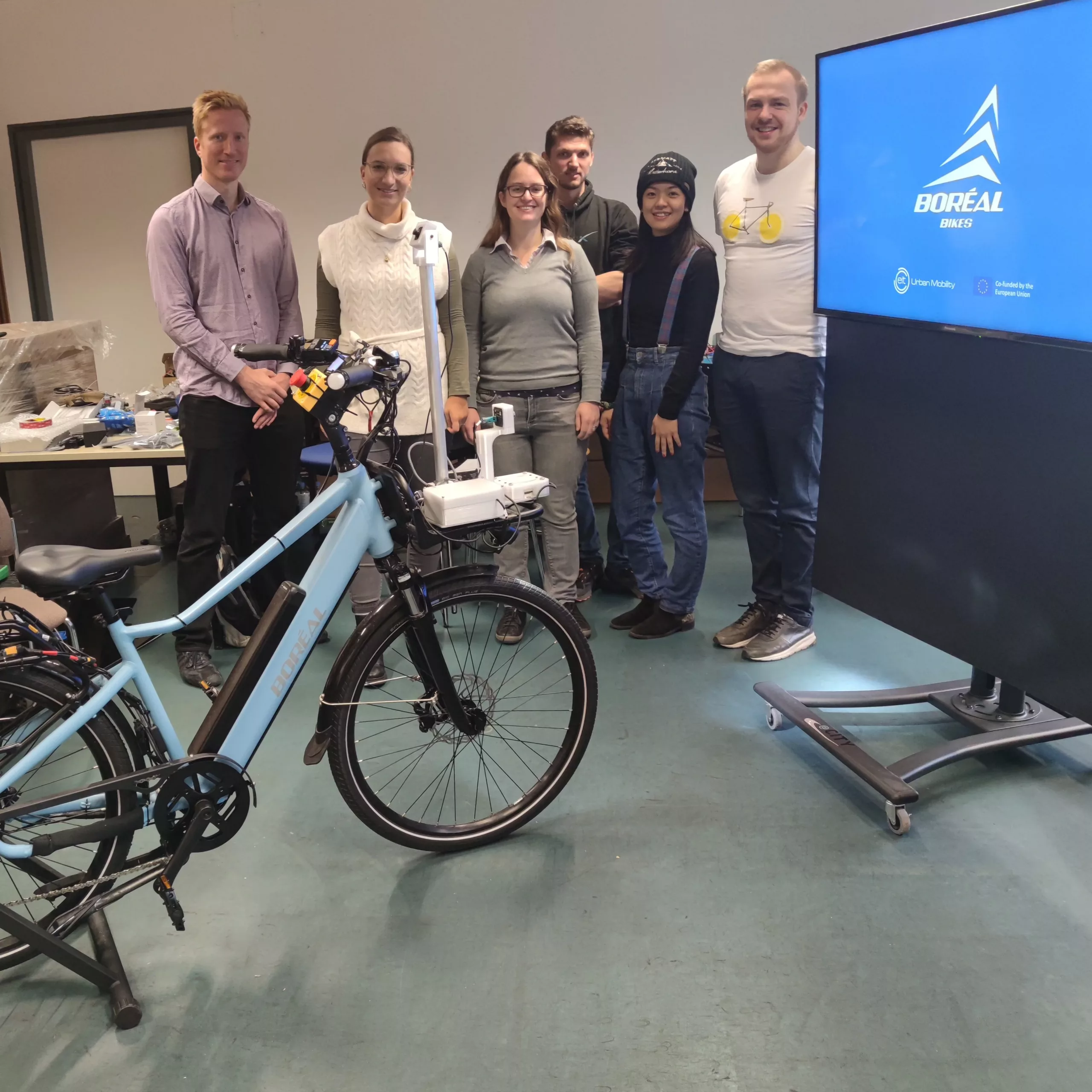
TUM announced a Boreal smart sensor e-bike in October 2023 for planned real-world STADT:up experiments on cycling behaviour, active mobility and road safety.
- Research base
- Munich, Germany
- Research group
- TUM — Chair of Traffic Engineering and Control
- STADT:up timeline
- January 2023 start; final presentation 10–11 June 2026
- Bicycle announcement
- 27 October 2023
- Boreal contribution
- Smart sensor e-bike for TUM’s research
- Instrumentation
- Cameras, 360-degree lidar, cycling-behaviour sensors and GNSS
01 / Research context
Understanding cyclists in automated urban traffic
Automated vehicles have to account for people cycling, complex junctions and changing traffic conditions. STADT:up — Solutions and Technologies for Automated Driving in Town — investigated automated driving in urban environments, including environmental perception, behaviour prediction and manoeuvre planning.
TUM’s Chair of Traffic Engineering and Control studied behaviour and manoeuvre planning in critical mixed-traffic situations involving vulnerable road users. Its Boreal bicycle announcement identified cycling behaviour, active mobility and road safety as areas for real-world experiments.
The project timeline describes STADT:up as a whole. It is not a schedule of Boreal-bike field trials.
02 / Research context
A sensor-equipped bicycle for field research
On 27 October 2023, TUM announced that a new smart sensor e-bike from Boreal Bikes had joined the chair. The announcement described preparations for real-world experiments using the bicycle within STADT:up.
TUM listed cameras, 360-degree lidar, cycling-behaviour sensors and GNSS among the bicycle’s equipment. GNSS provides satellite positioning; lidar measures distances to surrounding objects. Together, these instruments offer a mobile platform for observing cycling and its surroundings.
03 / Documented evidence
What the public record establishes
TUM publicly documented the bicycle’s arrival, its instrumentation and the intended research questions. Its announcement describes planned experiments, rather than reporting the results of a completed bicycle campaign.
The wider STADT:up consortium presented its automated urban-driving results on 10–11 June 2026 at the Aldenhoven Testing Centre. Those project-wide results should not be read as measured outcomes of the Boreal bicycle.
The reviewed public sources do not establish a completed Boreal-bike trial’s sample size, routes or quantified safety outcomes. No such findings are claimed here.
05 / Practical value
Bringing the cyclist’s perspective into research
An instrumented bicycle can bring the cyclist’s perspective into studies of mixed urban traffic. For TUM’s stated research aims, it offers a way to investigate active mobility on the street alongside work on automated vehicles and mobility models.
Sources & image credits
- TUM — Boreal Bike announcement, 27 October 2023 (opens in a new tab)
- TUM — STADT:up, Chair of Traffic Engineering and Control (opens in a new tab)
- STADT:up — final project presentation, June 2026 (opens in a new tab)
- DLR — STADT:up project results and consortium context (opens in a new tab)
- TUM — cyclist riding characteristics, September 2025 publication record (opens in a new tab)
- Cyclist riding characteristics paper — urban drone observations, not bicycle data (opens in a new tab)
Image retained from Boreal Bikes’ website. Boreal smart sensor bicycle at TUM. Existing project photograph, not a photograph of a completed field trial.
Start with a question
Discuss a study
What do you need to observe from the cyclist’s perspective? Boreal can contribute an instrumented bicycle platform to a collaborative study of behaviour, street conditions or interactions with automated vehicles.
Discuss a study