
Behaviour and junction research
Capturing cyclist interactions at an urban junction
At a working urban junction, DLR used a sensor-equipped research bicycle to study how cyclists interact with turning vehicles and with one another.
- Location
- Ringlerstraße/Hindenburgstraße junction, Ingolstadt, Germany
- Field campaign
- 27–29 June 2023
- Research partner and operator
- German Aerospace Center DLR
- Project
- SAVeNoW
- Boreal contribution
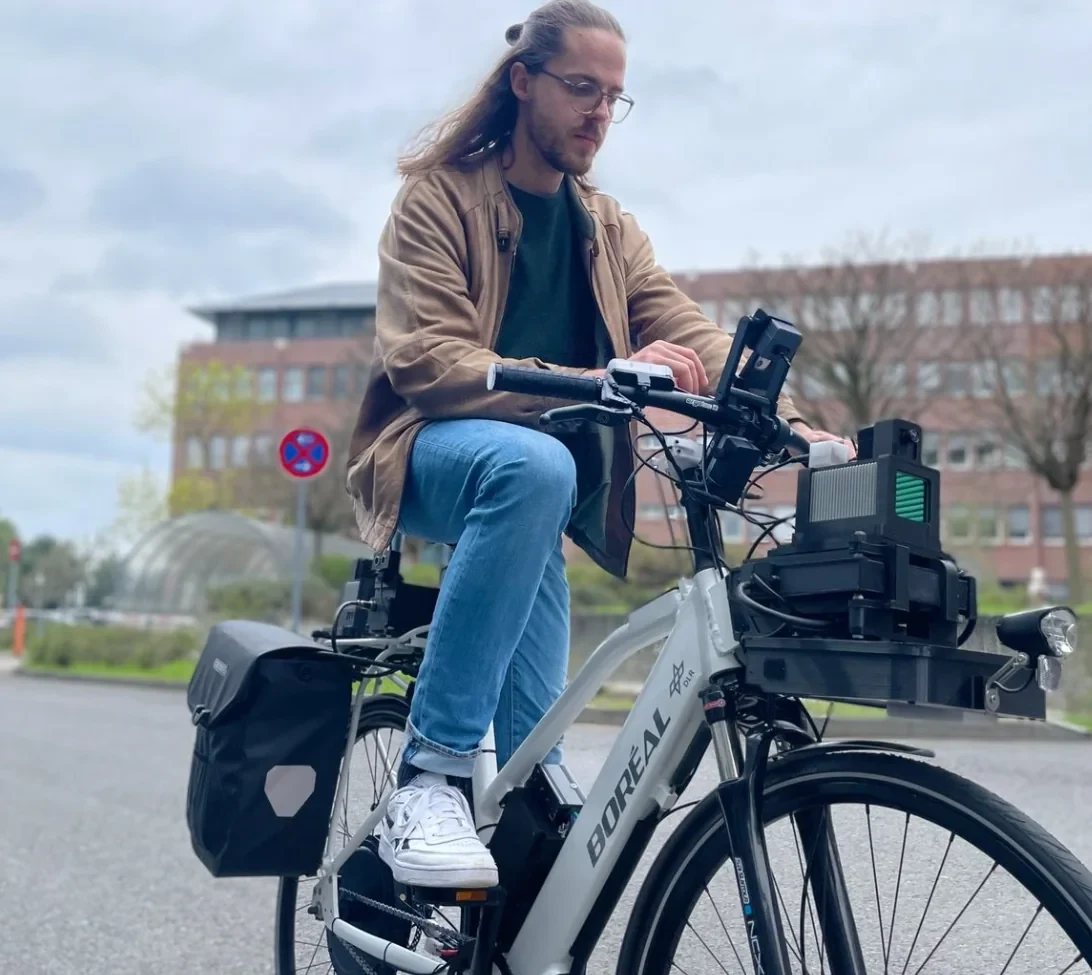
- Holoscene research bicycle platform used as DLR’s BoBBi research bicycle
- Scale
- one junction, three-day campaign, covering vehicle–cyclist and cyclist-following interactions
01 / Research context
The question
Right-turning vehicles and straight-ahead cyclists can meet in the same space. Understanding the approach, timing and movement of each road user helps researchers investigate these encounters. The SAVeNoW campaign also examined how cyclists follow one another.
02 / Research context
Boreal’s contribution
A Holoscene research bicycle provided the mobile sensing platform for DLR’s fieldwork. Its cyclist-level perspective complemented observations of the junction, enabling researchers to record interactions from within the traffic environment.
03 / Measurements & findings
What the campaign achieved
DLR collected interaction recordings at the Ringlerstraße/Hindenburgstraße junction over 27–29 June 2023. The deployment demonstrated the use of the research bicycle for operational data collection in an urban setting.
DLR’s published BoBBi methodology describes producing attributed cyclist trajectories and calculating distances to surrounding road users. It also describes deriving safety indicators such as time-to-collision and post-encroachment time. This provides a documented route from bicycle recordings to structured interaction analysis.
- 1
- Junction · Ringlerstraße/Hindenburgstraße
- 3 days
- Field campaign · 27–29 June 2023
The campaign recordings and DLR’s published processing methodology are distinct evidence. The methodology is not a quantified outcome of this specific deployment.
04 / Practical value
Why this matters
A junction encounter unfolds over time. Capturing the cyclist’s movement and surrounding traffic helps researchers examine how an interaction develops, rather than relying only on the number of road users passing through the location. The campaign illustrates the role mobile sensing can play alongside other research instruments.
SAVeNoW / Project film
See the fieldwork
English audio 2:54 Captions available
What you are watching
tv.ingolstadt report · English-dubbed version supplied by Boreal Bikes
Watch the local television report showing the SAVeNoW research bicycle test rides in Ingolstadt.
Download videoRead the English transcript
As a partner in the SAVeNoW project, the German Aerospace Center team traveled all the way from Berlin, bringing a very special bicycle with them. Today we are examining the [original German speech overlaps]. [Original German interview] Using the research bicycle fitted with special sensors and together with a test vehicle, uh, collecting the data. The vehicle is equipped with sensors and scanners to detect both itself and its surroundings. A screen by the passenger seat visualizes objects around the vehicle. The busy Hindenburgstraße-Ringlerstraße junction is serving as a research intersection, with a camera mounted on the roof of a residential building. Here at the junction, we have a specific scenario where we are basically studying a right turn. In other words, looking at the typical use case, we have a vehicle turning right and the cyclist going straight ahead, and, uh, investigating, as it were, how the cyclist interacts with the turning vehicle. So ultimately, analyzing this data to determine, okay, how do cyclists ride? How do cars drive? What behavioral patterns lie behind it? Kitted out with helmets and high-vis vests, the first test run was ready to begin. As the car turned and stopped to let the bicycle pass, data was recorded from both vehicles. This data can be used, among other things, to develop collision warning systems, which don't yet exist for bicycles. The sensor system is precisely used to determine, okay, how far away is the car from me? When do I start braking? Uh, when do I accelerate again? And so on, to actually gather kinematic data, identify behavioral patterns, and then use those for such a collision warning system. The publicly funded SAVeNoW project aims to create a digital twin of Ingolstadt. Achieving this goal requires a huge amount of research. On the one hand, for the digital twin, we first need all the static elements. That means everything that's road, buildings, traffic signs, whatever doesn't move. And on the other hand, the dynamic elements. Naturally, here in Ingolstadt, we have a lot of car traffic, but, but also lots and lots of pedestrians and cyclists. Data from the test runs feeds into the digital twin, allowing so-called what-if scenarios to be analyzed. Meaning, what happens, for instance, if we make structural changes to the junction here? What impact does that have on cycle traffic, for example? And that's why real-world data is essential to ensure our simulations are as true to life as possible. Anyone wishing to find out more about SAVeNoW's work can do so until the 31st of July at the Science Gallery, Ludwigstraße 39.
Sources & image credits
- SAVeNoW field campaign announcement (opens in a new tab)
- DLR BoBBi recording and processing methodology (opens in a new tab)
Image supplied by Boreal Bikes. The sensor-equipped Holoscene research bicycle used as DLR’s BoBBi platform.
Start with a question
Discuss a study
Which encounters at your junction need closer investigation? Boreal can help frame a measurement campaign around the interactions that matter.
Discuss a study