
Perception and research data
Cyclist perspective sensing for perception research
A bicycle sees the street from a different height and position than a car. TU Delft’s SenseBike provided a platform for collecting data that reflects that perspective.
- Location
- Delft University of Technology campus, Delft, the Netherlands
- Research partner
- TU Delft, Department of Cognitive Robotics
- Researchers
- Denniz Goren and Holger Caesar
- Published evidence
- BikeScenes paper submitted 29 October 2025; revised 30 August 2026
- Boreal contribution
- Holoscene X platform on which TU Delft’s SenseBike is based
- Scale
- 1.3 km campus loop, 3,021 consecutive LiDAR scans, 29 annotated classes
01 / Research context
The question
Perception models trained on automotive datasets encounter different viewpoints and sensor characteristics when transferred to a bicycle. The BikeScenes research investigated the value of bicycle-specific LiDAR data for recognising infrastructure and road users.
02 / Research context
Boreal’s contribution
TU Delft used SenseBike, a research platform based on Boreal Holoscene X. The researchers combined LiDAR, motion and positioning sensors, cameras and onboard computing to capture the cyclist’s environment.
03 / Research context
What the researchers produced
BikeScenes comprises 3,021 consecutive LiDAR scans recorded on a 1.3 km campus loop, annotated across 29 static and dynamic classes. A forward-facing camera supported labelling. The publication documents the recording, annotation and evaluation workflow, making the dataset useful for studying perception from a bicycle.
04 / Measurements & findings
What the results show
In the revised paper, fine-tuning a perception model on BikeScenes increased mean intersection-over-union from 13.8% to 63.6% on held-out subsequences. This is a measure of semantic segmentation performance: how closely predicted point labels match the reference labels. The result demonstrates the value of data suited to the bicycle’s viewpoint and sensor setup.
- 3,021
- Consecutive LiDAR scans in BikeScenes
- 29
- Annotated static and dynamic classes
- 1.3 km
- Campus recording loop
Reported by the paper’s authors, on held-out subsequences of one campus recording. This result does not establish generalisation across cities.
05 / Practical value
Why this matters
Recognising both the street’s physical features and the people moving through it is a foundation for analysing interactions. This work shows how a Holoscene-based research platform can support the creation of labelled datasets and the evaluation of cyclist-perspective perception methods.
Sources & image credits
- TU Delft research story (opens in a new tab)
- BikeScenes publication and version history (opens in a new tab)
- BikeScenes revised paper with platform and dataset details (opens in a new tab)
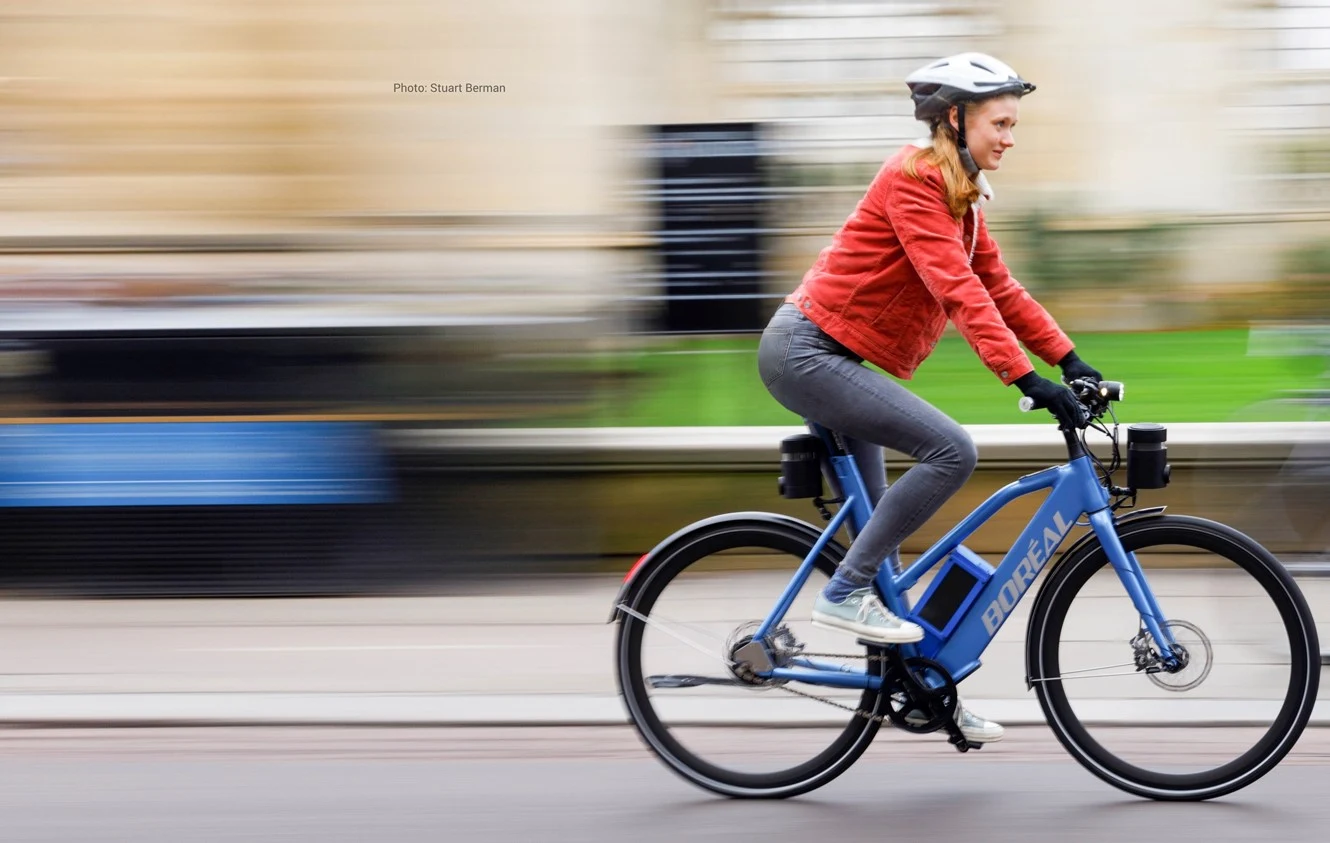
© Stuart Berman. Boreal Holoscene platform photograph — not the TU Delft SenseBike recording.
SenseBike / TU Delft film
How one bike is helping build smarter cities
Optional YouTube player Click to load
YouTube stays disconnected until you click “Load video”. Loading the player shares your IP address and browser information with Google/YouTube and may involve additional tracking. This choice applies only to this player on this page visit. Google privacy policy (opens in a new tab).
YouTube player not loaded.
About the film
Film: TU Delft. Preview photograph: © Stuart Berman — Boreal platform reference, not a frame from the film.
TU Delft introduces SenseBike, a bicycle equipped with cameras, lidar, GPS and inertial measurement systems for mobility research.
Watch on YouTube (opens in a new tab)If the embedded player is unavailable, use the link above. YouTube may require sign-in or restrict playback in some locations.
Start with a question
Discuss a study
Does your perception system understand the environment from the road user’s perspective? Boreal can help define a data-capture approach for your research question.
Discuss a study