
Connected mobility and V2X
Connected cycling and V2X warning trials
Bike2CAV explored how bicycles, vehicles and roadside infrastructure could exchange information to identify collision risks and warn people cycling.
- Locations
- Salzburg and Koppl, Austria
- Project period
- 1 September 2020–30 April 2023
- Project lead
- Salzburg Research
- Consortium
- Salzburg Research, AIT, University of Salzburg, Kapsch TrafficCom, Bike Citizens, BB Boreal Bikes and KFV
- Boreal contribution
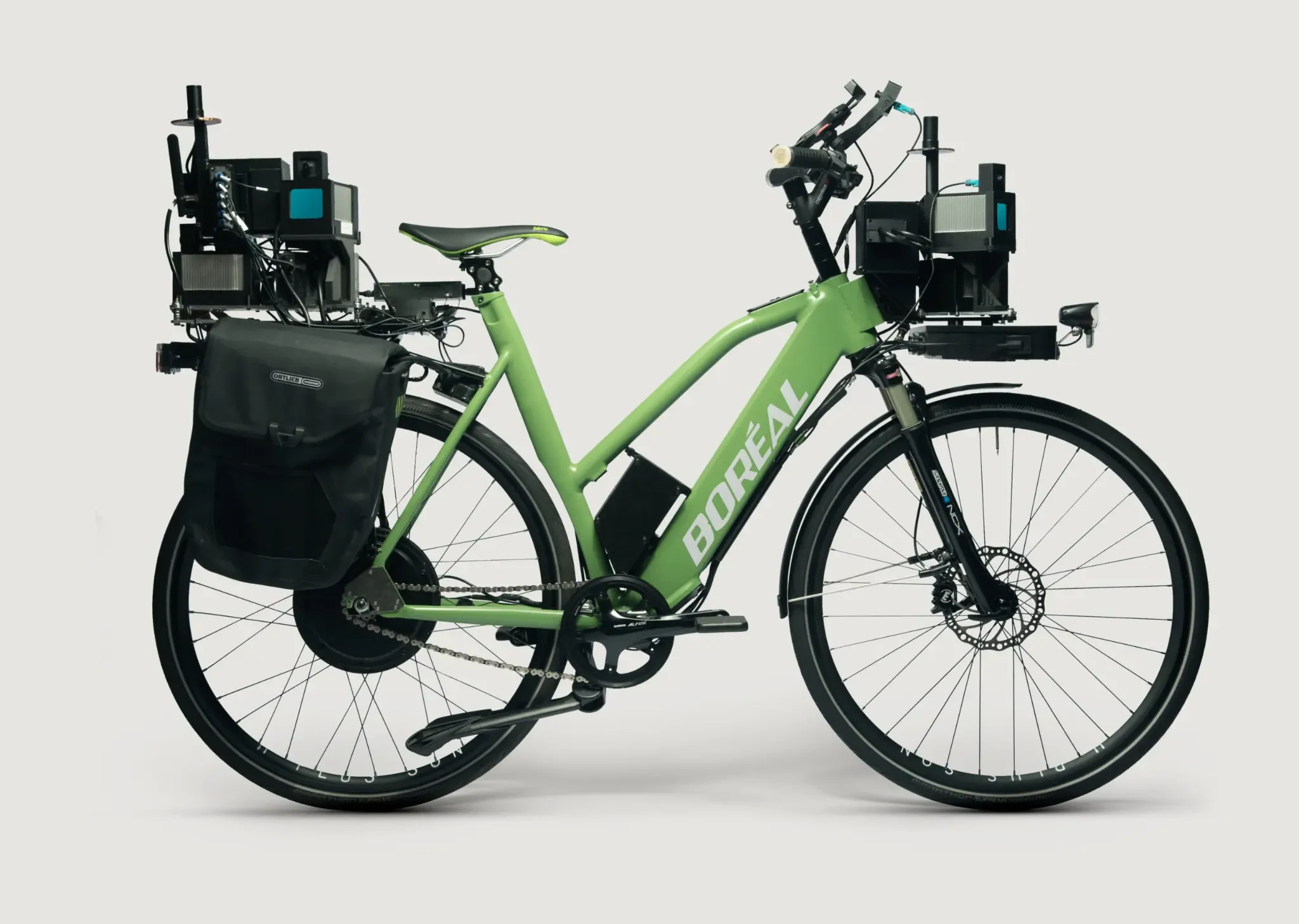
- development of the connected Holoscene Edge research bicycle
- Scale
- two junctions, six scenarios, final warning evaluation across 30 test rides
01 / Research context
The question
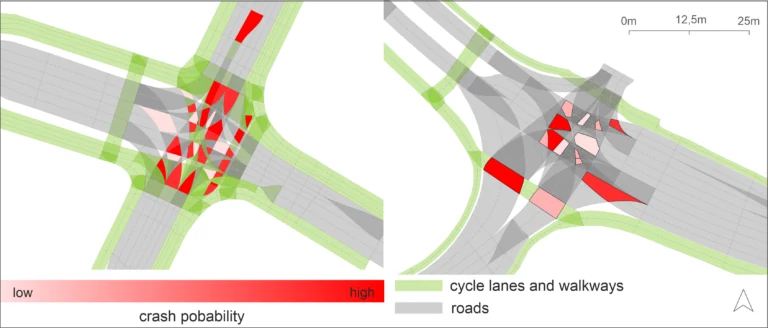
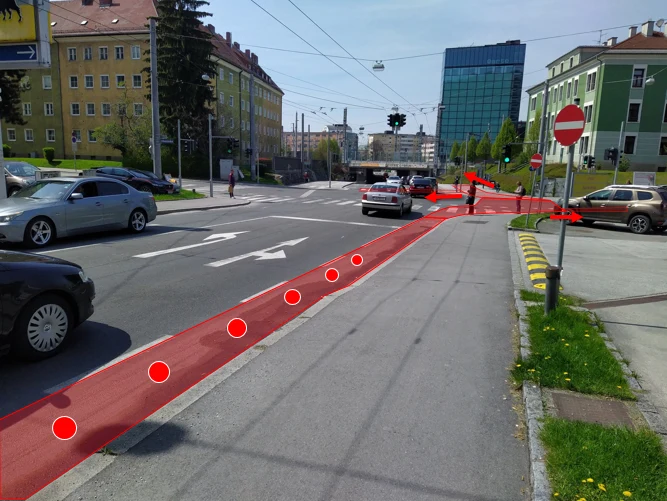
Detecting a cyclist is one part of understanding a potential conflict. The project investigated how connected road users and infrastructure could combine observations, estimate collision risks and communicate warnings to cyclists.
02 / Research context
Boreal’s contribution
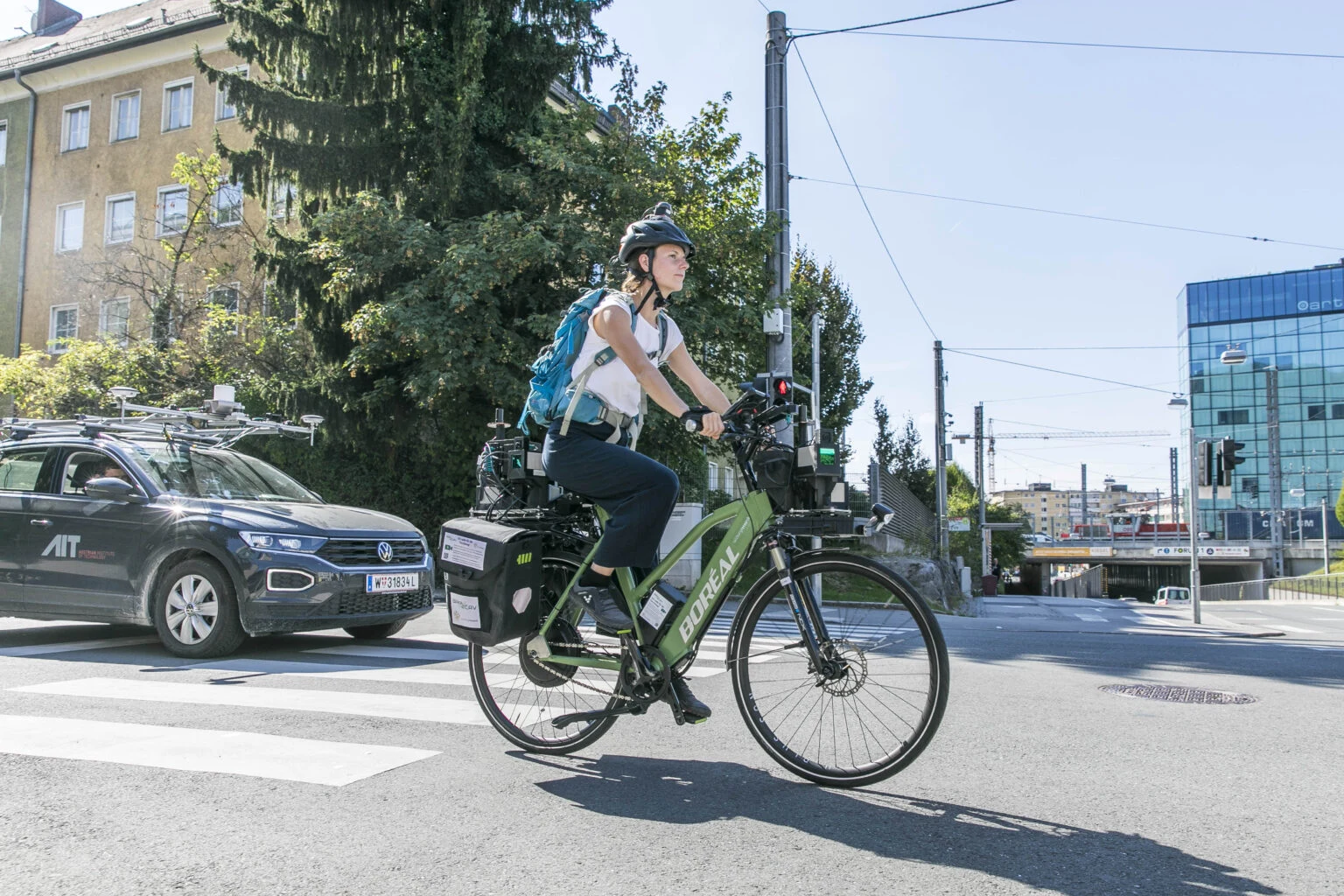
Boreal developed the Holoscene Edge research bicycle, integrating connectivity, edge computing and rider interfaces. Vehicle-to-everything communication, or V2X, enabled the bicycle to participate actively in cooperative detection rather than relying only on being observed by vehicle or roadside sensors.
03 / Research context
What the consortium tested
Trials used one urban and one rural junction, with three scenarios at each. The consortium tested communication between the bicycle, connected vehicle and roadside infrastructure, alongside collision-risk detection and warning concepts. The rider interfaces explored audible, visual and tactile warning channels.
04 / Measurements & findings
What was achieved
Collision warnings were generated in all six scenarios. The final evaluation reported that warnings could be transmitted in 27 of 30 test rides involving genuinely hazardous situations. The integrated demonstrator established a proof of concept and identified the integration and processing work needed for further development.
- 2
- Junctions · one urban and one rural
- 6
- Scenarios · collision warnings generated in each
- 27/30
- Hazardous test rides · warnings transmitted
Consortium proof-of-concept evaluation. Warning transmission is not a collision-reduction rate or a production reliability measure.
05 / Practical value
Why this matters
The project gave Boreal practical experience of integrating a research bicycle into a connected junction environment. It shows the complementary roles of bicycle sensing, communications, vehicle perception and infrastructure in a cooperative system.
Bike2CAV / Field context
Photographs & project illustrations
Bike2CAV / Project film
Connected cycling in the field
English audio 2:26 Captions available
What you are watching
Bike2CAV project film · English-dubbed version supplied by Boreal Bikes
This project video explains how the connected bicycle, vehicle and roadside infrastructure exchanged information, detected potential conflicts and delivered warnings to cyclists during the Bike2CAV trials.
Download videoRead the English transcript
A connected bicycle, a connected vehicle, and connected infrastructure. Particularly at junctions, hazardous situations constantly arise between cyclists and cars or lorries. New technologies for vehicle and infrastructure connectivity offer a huge opportunity to prevent collision risks in the future through early detection and warnings. In Salzburg, wireless communication between various vehicles and bicycles was validated under real-world conditions for the first time. Through cooperative detection, vehicles and infrastructure share information about traffic and hazard situations. A key feature of this research is that cyclists are not only detected, but are also actively involved in collision avoidance. To do this, for instance, visual signals on the warning app and simultaneous audio signals inside the cycle helmet are used. Six different scenarios were used to test how potential collisions between vehicles and bicycles can be detected and prevented. Everyone involved benefits. Cyclists receive advance warning. Thanks to cooperative detection, connected vehicles and driver assistance systems recognize cyclists even in challenging situations, allowing them to react earlier. Local councils and infrastructure operators can objectively assess junctions for potential risk and proactively defuse hazard zones with targeted measures. Near misses never show up in accident statistics. With smart technology, these risks can be assessed more effectively and action taken before anything happens. This research project is funded by the Federal Ministry for Climate Action, Environment, Energy, Mobility, Innovation, and Technology as part of the Mobility of the Future RTI program.
Sources & image credits
- Bike2CAV project and consortium (opens in a new tab)
- Bike2CAV final project report (opens in a new tab)
- Bike2CAV press gallery and image credits (opens in a new tab)
© Boreal Bikes. The connected Holoscene Edge research bicycle developed by Boreal for Bike2CAV. Photographs and illustration credits are shown beside each asset. Video supplied in English by Boreal Bikes.
Start with a question
Discuss a study
What information needs to move between a cyclist, a vehicle and the junction? Boreal can contribute bicycle sensing and connectivity to a collaborative trial.
Discuss a study